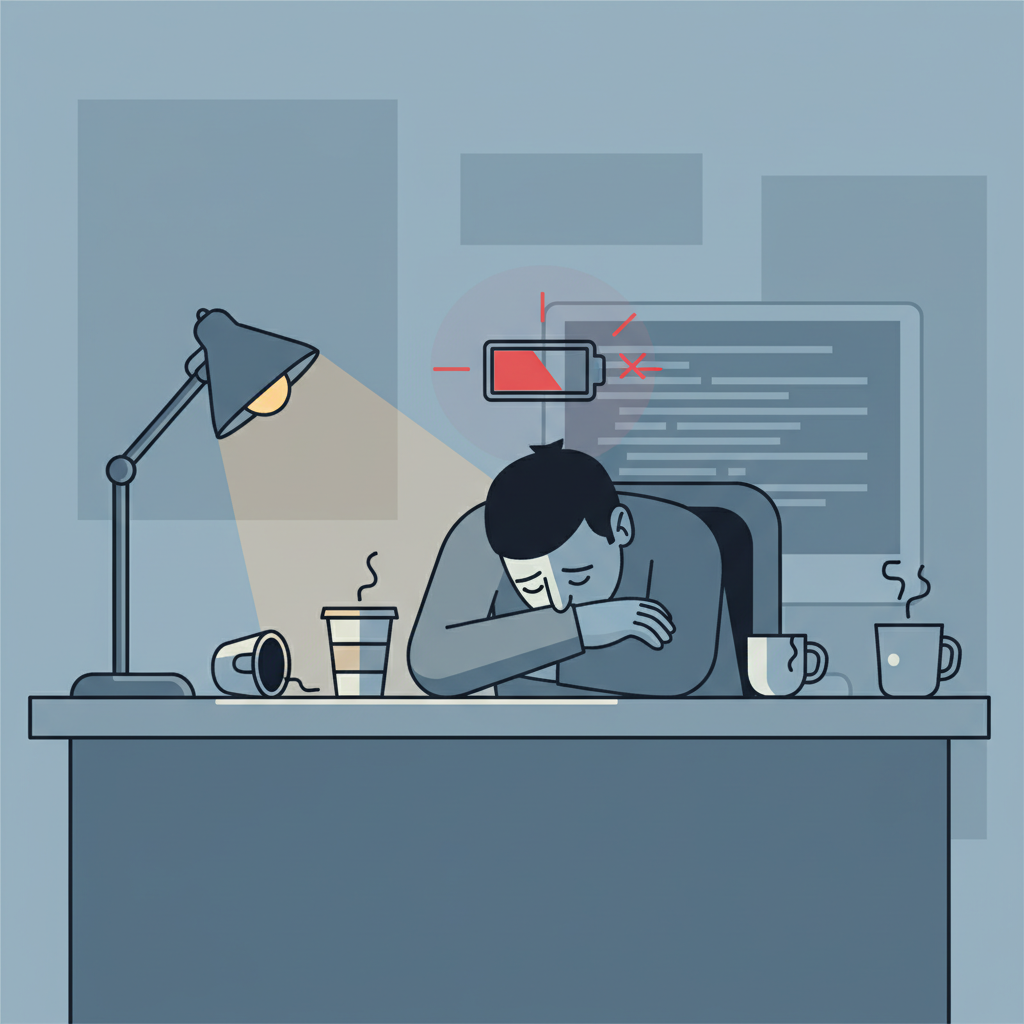
You wake up, open your laptop, stare at the code you were writing last night, and feel absolutely nothing. Not frustration. Not excitement. Just... nothing. The cursor blinks. You check Slack. You check Twitter. You check Slack again. Twenty minutes gone.
You used to love this. You remember staying up until 3am because you were in it — chasing a bug, building a feature, learning something new. Now you're staying up until 3am because you can't stop doomscrolling, and the thought of opening your IDE tomorrow makes your chest tight.
That's burnout. Not the LinkedIn version where someone posts about "learning to set boundaries" with a sunset photo. The real version, where you're questioning whether you even like programming anymore.
What It Actually Feels Like
The productivity advice people love to give ("just take a break!") comes from people who've never experienced real burnout. A break doesn't fix burnout. Burnout isn't being tired. Being tired is what happens after a hard sprint. You sleep, you recover, you're back.
Burnout is different. It's:
- Writing the same line of code three times because you can't hold the logic in your head anymore. Your working memory is shot.
- Dreading pull request reviews — not because the code is bad, but because you don't have the energy to care about whether a variable should be camelCase or snake_case.
- Starting side projects and abandoning them within hours. Not because you lost interest. Because you never had it. You were trying to feel something.
- Feeling guilty about not coding on weekends while simultaneously feeling resentful that coding is all you do.
- Imposter syndrome on steroids. Everyone else seems to be shipping, learning new frameworks, building in public. You can barely get through your Jira tickets.
- Physical symptoms. Headaches. Jaw clenching. Insomnia. Back pain that no ergonomic chair fixes because the tension is coming from your nervous system, not your posture.
The worst part is the guilt. You have a good job. Good salary. You work from home. You should be grateful. So you push through another sprint, attend another standup where you say "all good, making progress," and quietly die inside.
How We Got Here
The tech industry has a unique talent for dressing up exploitation as culture.
"We're a family." No, you're a company. Families don't do performance reviews.
"We work hard, play hard." Translation: we expect 60-hour weeks but there's beer in the fridge.
"Passion-driven." Translation: we're going to underpay you and expect you to make up the difference with enthusiasm.
Always-on culture. Slack notifications at 9pm. "Quick question" messages on Saturday. The implicit expectation that you're reachable, always, because your laptop is ten feet from your bed.
The learning treadmill. Every six months there's a new framework, a new paradigm, a new way your skills are becoming obsolete. React, then Next, then Server Components, then RSCs in App Router, then React 19, then Server Actions. You never get to feel competent. You're always a beginner at something.
AI anxiety. Now there's a layer on top: will AI replace you? Should you be learning prompt engineering? Is your job safe in two years? Three? The existential dread is new and it's everywhere.
Remote work isolation. You traded the commute for loneliness. Your "coworkers" are Slack avatars. You haven't had a real conversation about code — the kind where you're both staring at a whiteboard and arguing — in months. Maybe years.
The Things Nobody Says Out Loud
It's okay to not have a side project. You're not falling behind. The people tweeting about their side projects at 11pm are either in a different season of life, or they're heading toward the same wall you already hit.
Nobody checks your GitHub contributions graph. Seriously. No one is looking at your green squares except you. The contributions graph is a guilt machine and nothing else.
"Just take a vacation" doesn't work if you spend the entire vacation thinking about the work piling up. The problem isn't insufficient vacation. The problem is the system that makes you feel guilty for taking it.
Senior engineers burn out differently. Juniors burn out from imposter syndrome and information overload. Seniors burn out from decision fatigue, context-switching across too many projects, mentoring while maintaining their own output, and the slow realization that they've been doing the same thing for ten years with different syntax.
The people who seem fine are often not fine. The tech lead who ships every sprint and always has energy in standups? They might be running on caffeine and anxiety. Burnout is invisible until it's catastrophic.
What Actually Helps
I'm not going to tell you to meditate. (Although if that works for you, great.) Here's what actually helps, based on people who've been through it:
1. Reduce the Inputs
You don't need to read Hacker News every day. You don't need to know about every new framework. You don't need to be on Twitter, Reddit, Discord, three Slack workspaces, and LinkedIn simultaneously.
Unsubscribe from the newsletters. Mute the channels. Turn off notifications after 6pm — not because a productivity guru said so, but because your brain needs silence to recover.
2. Ship Something Small
Not a project. Not a startup. Something small and stupid that works. A JSON formatter that just... formats JSON. A script that renames your screenshots. A CSS animation that makes you smile.
The point isn't the output. The point is remembering what it feels like to build something without stakeholders, deadlines, or sprint points attached to it.
3. Talk to Someone Who Isn't in Tech
Your non-tech friends don't care about your stack or your sprint velocity. They ask "how are you?" and they actually mean it. The perspective shift is jarring and necessary.
If you don't have those friends anymore because you've been buried in work for years — yeah, that's part of the problem.
4. Lower Your Standards (Temporarily)
Your code doesn't have to be perfect. Your PR descriptions don't need to be novels. Your test coverage doesn't need to be 100%. Do the minimum viable job for a while. Nobody will notice, and you'll stop hemorrhaging energy on things that don't matter.
"Good enough" is good enough. Especially right now.
5. Consider That the Job Might Be the Problem
Sometimes burnout isn't about you. Sometimes it's a toxic team, an incompetent manager, unrealistic deadlines, or a product you don't believe in. No amount of self-care fixes a bad environment.
If you dread Monday every single week, that's not a you problem. That's a job problem.
6. Move Your Body
I said I wouldn't give generic advice, but this one is real: physical movement is the fastest way to regulate a burnt-out nervous system. Not because "exercise is good for you" — because your body is storing weeks or months of stress hormones that only get metabolized through physical activity.
Walk. Lift. Swim. Punch a bag. Whatever. Twenty minutes. The code will still be there when you get back.
The Recovery Is Slow
Nobody tells you this part: recovery takes months, not days. You don't take a week off and bounce back. A week off with burnout is just a week of dreading the Monday after.
Real recovery might mean setting boundaries your manager doesn't love. Might mean switching teams. Might mean leaving a job that looks great on paper but makes you miserable in practice. Might mean stepping away from the industry entirely for a while.
The Jira board will survive without you. It always does.
Anyway
I don't have a neat conclusion for this. There's no five-step framework for un-burning-out. Some people switch jobs and feel better immediately. Some people take six months off and still feel empty when they come back. Some people just... slowly get better by doing less for a while.
The only thing I know for sure is that ignoring it makes it worse. Every time.